Minor Spoilers Ahead
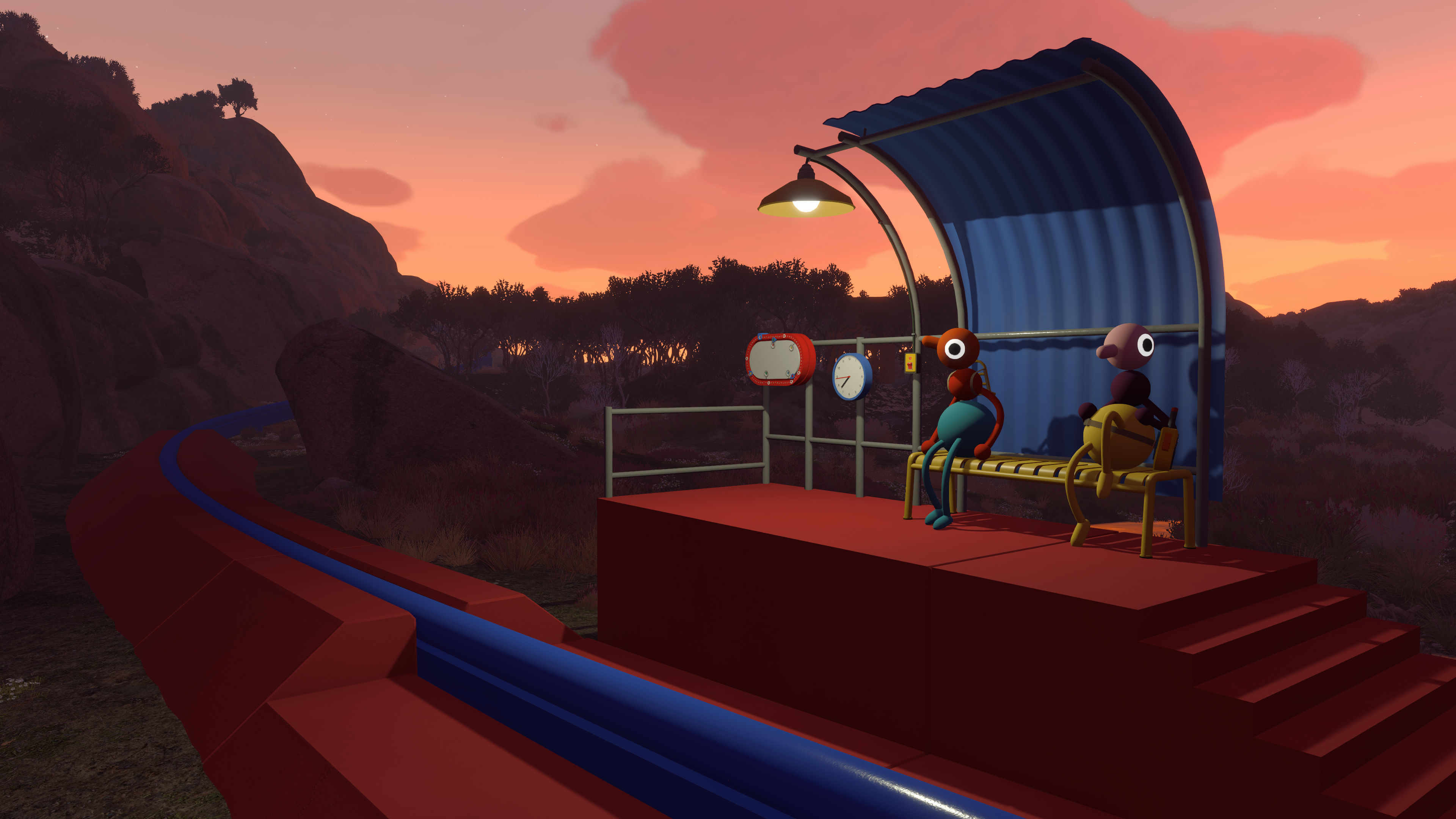
Big Walk is another avian adventure from House House, the team that brought us Untitled Goose Game. This time the twee English town has been substituted for a verdant island, complete with squeaking beaches and Kookaburras chortling unseen in the dense foliage. Dropped into this Pacific paradise you and some number of friends roam the terrain solving puzzles, which in turn produce gourd-shaped prizes, which can then be arranged at the top of large colourful towers, which in turn will unlock local conveniences to aid quicker and broader travel to find more gourds - rinse, repeat.
Our expedition - conducted over a handful of Sunday evenings - was as a party of three: Ostensibly the minimum required to play. The game’s star attraction is its proximity chat, which is exploited to isolate players from each other when not in immediate company. The proliferation of Discord means that constant communication in modern gaming is presupposed, and House House compensates for its absence with a suite of player gestures, tools and physics. Moving communication into a diegetic context also allows for some interesting spatial tricks, like how speech reverberates through a tunnel, or echoes across a valley.
Each puzzle scales with the party size, so our experiences may not be representative of most players, but many situations can be summarised as a game of ’telephone’. One player acts as a messenger between a room containing the puzzle solution and a room containing the interface to input said solution, each occupied by the other isolated players. Some of the puzzles require dexterity, but House House take pains to craft scenarios where deliberate and clear communication are the main factors. One puzzle simply asks that you sit in a room together for five minutes.
Beyond the initial handful of puzzles, traversal of the island is non-linear, so parties are free to break off into seperate expeditions and scour the mountains and beaches separately. Utilities such as backpacks can be scavenged to provide some relief from the limited inventory space (initially just your hands), but even so your party’s combined inventory limit means that you will need to offload collected gourds at interval, providing opportunities for regrouping and debriefing at the aformentioned towers. Our party being the size it was, our reasons for separating were mostly manufactured by the puzzles, and even then only for a few minutes at a time. We would spend more time deliberating over communications methods and fallback scenarios if we got separated than we actually spent apart. But finding yourself stranded at night at the bottom of a canyon after a botched attempt to navigate a log bridge is a conundrum that few games allow a player to sit with for long, and this friction is a welcome surprise.
The abstract structures and objects that make up the Big Walk landscape are foreign, and yet rendered simply in bright colours and basic shapes. Intuition and shorthand become how you relate to the island, and make it familiar. You develop a nomenclature specific to you (‘gourd’ is not a House House-prescribed term). Over time the island and it’s secrets become less obtuse. You might even find yourself disappointed, looking for substrates of mystery that never present themselves - a hangover of the medium that gave us Myst and The Witness. The last hour of the game presents a final test, further limiting your team’s ability to communicate by stealing all your items and some of your verbs while handing you a gauntlet of puzzles to send you off. By this point - if House House have done their job - you won’t need those items and verbs anymore.