Over the past decade the Silent Hill franchise has become an analogue for its titular town: disjointed, confused and a mirror of its greatest sins. Pyramid Head, rather than an intimate manifestation of one character’s guilt, has become a horror icon and masthead for the series, appearing in multiple iterations of the extended Silent Hill universe including a range of Pachinko machines. The series became mired in uninspired sequels by disparate developers separate from Team Silent - a victim of its own success. Attempts to resurrect the series via Kojima’s viral PT in the 2010s were abandoned and it is not until the past couple of years that Silent Hill has begun its renaissance. Hot on the heels of last year’s Silent Hill f and Bloober Team’s recent remake of series darling Silent Hill 2, Silent Hill: Townfall expands on the idea that Silent Hill is not a place, but a vibe.
Simon Ordell washes ashore on the rocky pier of St. Amelia, a sleepy Scottish island, summoned by a man called Richard and haunted by a disaster to which he is inextricably linked. On his odyssey through the quaint seaside streets, we establish his relationship with Zoe, a nurse at the local family clinic, overworked and wracked with guilt.
Townfall is in many ways a Covid game. In a game populated by otherworldly horrors and constant physical peril, it’s notable that one of the most stress-inducing sequences requires the player to perform medical intervention under the disdainful supervision of a doctor on the other end of an intercom. Menacing medical iconography is prevalent; surgical knives unlock fleshy locks and tendril-like sutures protrude from the yawning chest cavities of shambling humanoid monsters that occupy the otherwise vacant streets, houses and shops. Whereas previous Silent Hill titles have grappled with the internalized guilt of individuals and how these manifest, Townfall is more of an ensemble piece - a meditation on a collective trauma. Flowers and written tributes to lost members of the community decorate a statue in the town square, reminiscent of a war memorial. Handwritten signs in shop windows and empty shelves hint at a catastrophe that has otherwise left the idyllic rows of cottages and village greens untouched. It’s a juxtaposition that will be familiar to players of The Chinese Room’s Everybody’s Gone To The Rapture.
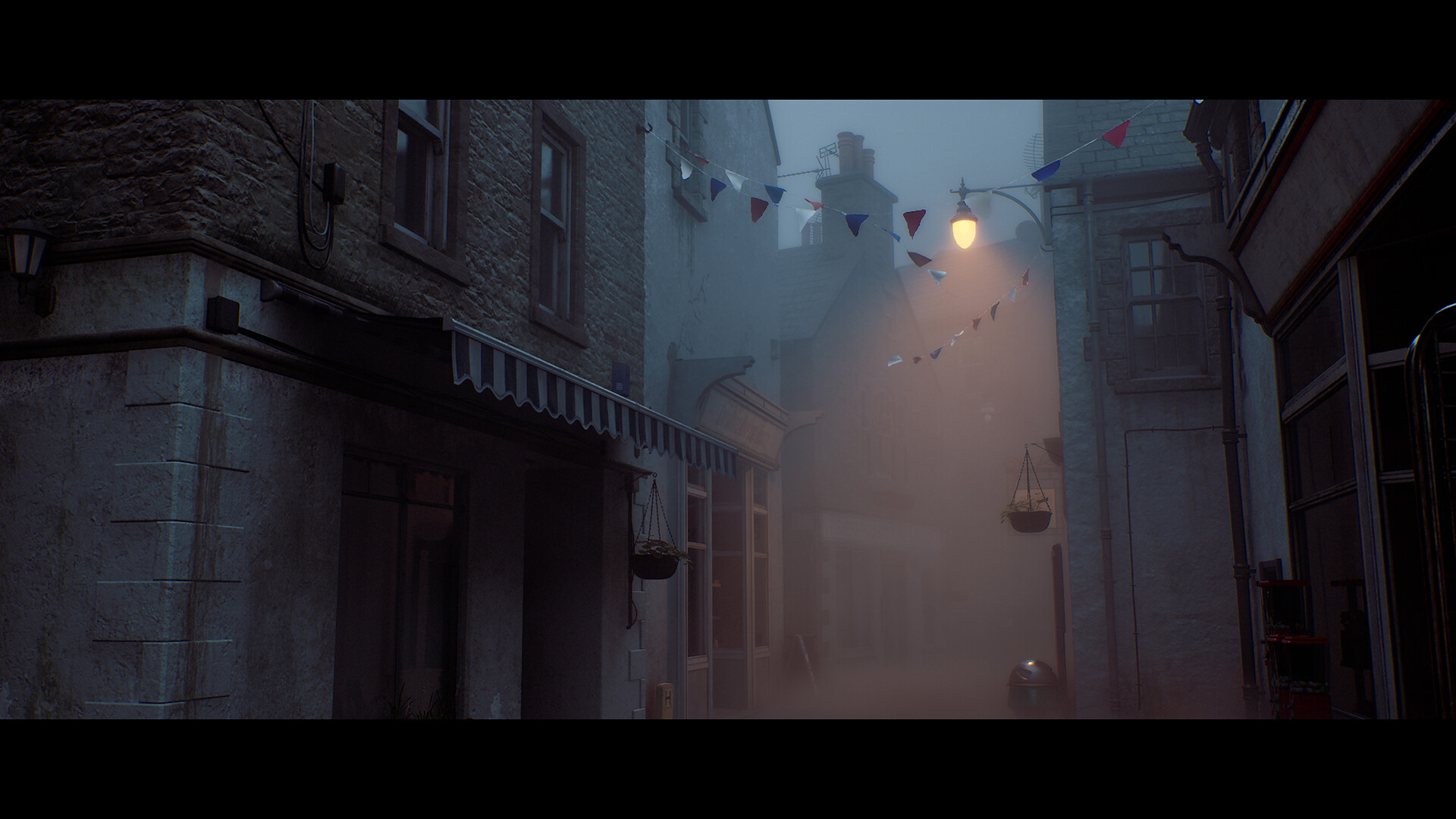
For the first time the series provides three separate protagonists through which to peel back the layers and piece together the inciting incident. One of the more modern changes is the shift to first person. Now the suffocating fog of St. Amelia feels ever closer - given depth and impenetrability by Unreal Engine’s volumetric technology. Unlike the industrial otherworld of entries’ past, Simon finds himself in overbearing brutalist mazes forged from solid rock and dramatically lit by shafts of crimson light. Moisture pervades every surface, causing wallpaper to slough off the walls of abandoned homes in sheets. Objects are suffocated in thick poured concrete - a metaphor for the foundations put down in St. Amelia by the Chapman Energy Group, a conglomerate with offshore drilling aspirations.
Combat has never been the series’ strongpoint - some would argue that the uninspired and awkward controls are intended to dissuade players from engaging in conflict - but in Townfall the influence of Outlast and Amnesia: The Dark Descent are worn on it’s IV-dripped sleeve. With the hallmark radio substituted for a portable CRT, hiding and evasion are prevalent mechanics, causing fatigue and friction when matched against the eagle-eyed and erratic AI. Since this review the game has received a patch that lobotomises the denizens of St. Amelia further in addition to fixing some notable performance issues. Weapons are plentiful, however your designated ending (of which there are a handful) depends on how fervently you engage with enemies. Unbeknownst to the player, you incur penalties for every enemy felled, despite one protracted sequence later in the game encouraging a more direct approach.
Although set on a different continent than its namesake, Townfall’s most enduring character - as ever - is the town itself. Janky title aside (a play on downfall?) Screen Burn’s contribution to the Silent Hill pantheon is a worthy addition. Hopefully, despite a more muted reception than Silent Hill f, Konami are not discouraged from continuing to reimagine Silent Hill in bolder contexts.